AI Employee Training: How to Upskill Your Team in 2026
Only 13% of workers have received AI training. Learn how to build an AI employee training program that drives real adoption — with measurable ROI.
Chris Miller
6/26/20268 min read


You've invested in AI tools. You've got the licenses. You've sent the announcement email.
Three months later, half your team isn't using them and the other half is using them wrong.
This is the most common outcome for organizations that skip structured AI employee training and assume people will figure it out. They won't. Not because they can't, but because using AI effectively is a skill that has to be taught, practiced, and reinforced just like any other.
The gap is stark: 94% of CEOs rank AI skills as their top priority, yet only 13% of workers have received any meaningful AI training [VirtualSpeech, 2026]. That gap is why 74% of organizations report no clear ROI from their AI investments — not because the tools don't work, but because the people using them haven't been properly equipped.
This guide shows you exactly how to fix that.
AI Employee Training: How to Upskill Your Team in 2026
How to Measure AI Training ROI
The Most Common AI Training Mistakes
Table of Contents
Why Most AI Training Programs Fail
Most AI training programs fail for the same reason: they treat AI like software onboarding rather than skill development.
A one-hour lunch-and-learn followed by a link to a tutorial doesn't build lasting capability. It produces temporary awareness and temporary awareness doesn't change behavior.
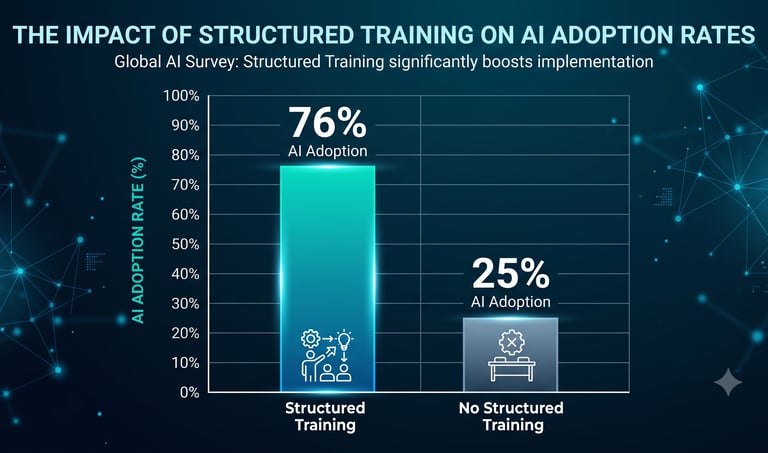
The evidence backs this up. Organizations with structured, formal AI training achieve a 76% AI adoption rate. Those without structured programs land at just 25% [Infonaligy, 2026]. The tool is identical. The training makes all the difference.
There are three root causes behind failed programs:
1. Generic, not role-based. A course called "Introduction to AI" means different things to a customer service rep than to a finance analyst. When training isn't connected to someone's actual daily work, it gets filed under "interesting but not relevant" and forgotten.
2. Theory without practice. Reading about how to prompt an AI tool is not the same as using one under realistic conditions. If your training doesn't include hands-on exercises with real business scenarios, retention collapses.
3. Adoption tracked, results ignored. Most organizations measure who completed the training module. Almost none measure whether those people are actually applying AI in ways that save time or improve output. Without output metrics, you can't improve the program and you can't justify continued investment.
The 4 Layers Every AI Training Program Needs
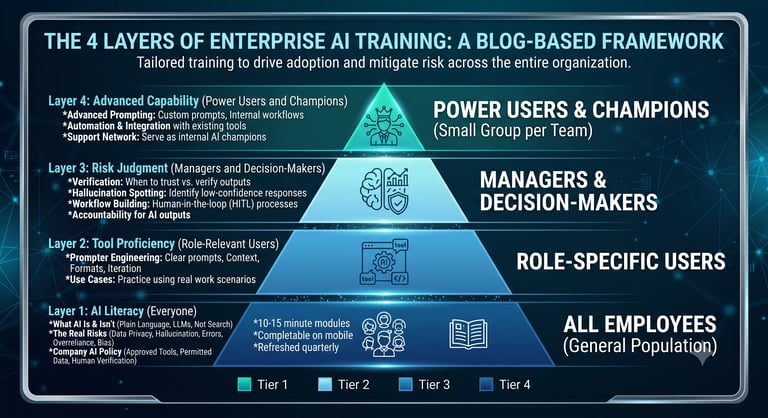
Effective AI employee training isn't one program it's four distinct capability layers, each building on the last.
Layer 1: AI Literacy (Everyone)
Every employee needs this, regardless of role, seniority, or technical background. Layer 1 covers three things:
What AI is and isn't. Explain large language models in plain language what they generate, what they hallucinate, and why they're not a search engine.
The real risks. Data privacy exposure, AI-generated errors presented as facts, overreliance, and bias. Staff need to understand these before they touch the tools.
Your company's AI policy. Which tools are approved? What data can be entered into them? What outputs need human verification before use? This is non-negotiable and must come early.
Layer 1 training works best as microlearning: 10–15 minute modules, completable on mobile, refreshed quarterly.
Layer 2: Tool Proficiency (Role-Relevant Users)
This is where employees learn to use the specific tools relevant to their work. The core skill at this layer is prompt engineering how to communicate with AI to get useful, accurate output.
Cover: how to write a clear prompt, how to give context, how to ask for a specific format, and how to iterate when the output isn't right. Then build in practice time using real work scenarios from your business, not generic examples.
Layer 3: Risk Judgment (Managers and Decision-Makers)
This layer is for people who will oversee AI-assisted work or make decisions based on AI-generated outputs. They need to understand:
When to trust AI output and when to verify it independently
How to spot hallucinations or low-confidence responses
How to build AI-assisted workflows that still include appropriate human review
Their accountability for AI outputs that affect others
Layer 4: Advanced Capability (Power Users and Champions)
A small group in every team will go further building custom prompts, creating internal workflow automations, or integrating AI with existing tools. These are your AI champions. Invest disproportionately in them. They become the internal support network that sustains adoption long after the formal training program ends.
How to Build Role-Specific AI Learning Pathways
The fastest way to lose employee buy-in is to make AI training feel irrelevant to their job. Role-specific pathways fix this by connecting every lesson to work the employee actually does.
Here's how to build them:
Step 1: Map the high-frequency tasks. For each role, list the five tasks your employees do most often. Customer service teams: drafting responses, summarizing tickets, escalation triage. Finance teams: report writing, data interpretation, compliance documentation. Marketing: content drafts, brief creation, research synthesis.
Step 2: Identify where AI saves the most time. For each task, ask: could AI do a first draft, a summary, or a classification that reduces the human effort by 30%+? Those are your priority training scenarios.
Step 3: Build prompts for those scenarios. Don't make employees develop prompts from scratch. Write 3–5 tested, ready-to-use prompts for each high-value scenario and include them in training. This dramatically shortens the time-to-value curve.
Step 4: Schedule regular practice. A workshop followed by nothing doesn't stick. Block 30 minutes per week for teams to apply AI to active projects. This isn't extra work — it replaces manual time with AI-assisted time, and the improvement compounds.
Real example: A customer service team trained with role-specific prompts for complaint response saw first-draft quality improve enough to reduce average handling time by 22% within six weeks. The training wasn't about AI in general — it was about this team's specific work.
Training Formats That Actually Work
Not all training formats deliver equal results for AI upskilling. Here's what the data shows:
The critical insight: most organizations run training annually. That's not enough for a skill that evolves as fast as AI does. Monthly touchpoints even short ones dramatically outperform a single annual event.
Digital training, when properly designed, is 93.7% more effective at helping employees meet organizational goals than traditional classroom methods [Murf AI, 2025]. The format matters less than the frequency and the relevance.
One caution: employees who receive at least 5 hours of AI training show significantly higher regular usage and confidence compared to those who receive less [All About AI, 2026]. Don't underestimate the minimum effective dose.
How to Measure AI Training ROI
This is where most programs fall apart. Seventy-four percent of organizations report no clear ROI from AI — and the core problem is measurement, not performance [TechClass, 2026].
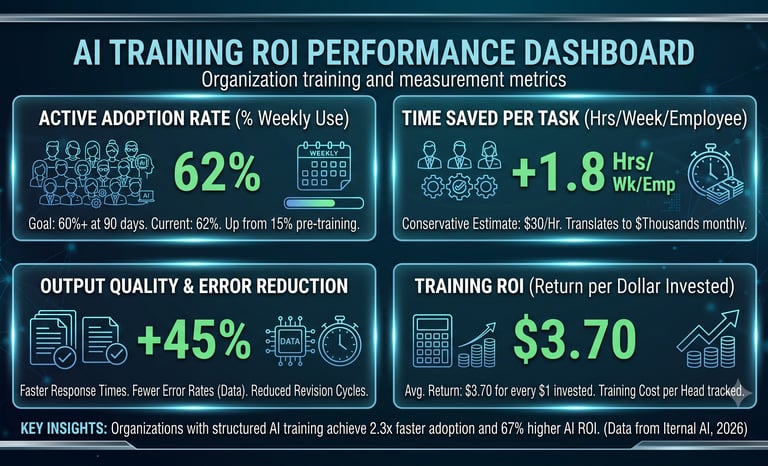
You can't manage what you don't measure. Track these four metrics from day one:
1. Active adoption rate. What percentage of trained employees are using approved AI tools at least weekly? Target: 60%+ at 90 days post-training. If you're below this, the training isn't translating to behavior change.
2. Time saved per task. Survey teams on hours saved per week on specific tasks before and after training. Even a conservative 1–2 hours per employee per week at $30/hour calculates to thousands of dollars monthly across a team.
3. Output quality. Track downstream quality metrics: fewer revision cycles on documents, faster customer response times, reduced error rates in data processing. These are the numbers that resonate with senior leadership.
4. Training ROI. Formal AI training programs return an average of $3.70 per dollar invested [Iternal AI, 2026]. Document your training cost per head and compare it against your measured time savings. If you can't make this calculation, your measurement is incomplete.
Organizations with structured AI training achieve 2.3x faster AI adoption and 67% higher AI ROI than those without [Iternal AI, 2026]. Those numbers come from measurement discipline, not luck.
The Most Common AI Training Mistakes
Trying to train everyone on everything at once
The AI tooling landscape is vast and changes constantly. Covering every tool in one training program produces overwhelm, not competency. Pick 1–2 tools, master them, then expand.
Treating the training as a one-time event
AI capabilities change every few months. A training program built in early 2025 is already partially outdated. Build a review cycle into your program quarterly at minimum so content keeps pace with the tools.
Skipping the policy conversation
Employees who don't know what data they can or cannot enter into AI tools will make their own judgment calls. Some of those calls will create compliance or security exposure. Your AI acceptable use policy must be part of Layer 1 training not a separate document buried in the intranet.
Ignoring the skills gap at the manager level
Managers who don't understand AI can't coach their teams to use it, recognize good AI-assisted work, or integrate AI into team workflows. Train managers first, or at minimum in parallel with their teams.
Measuring completion instead of capability
The number of employees who finished the training module tells you nothing about whether they can use AI effectively. Build assessments and real-task exercises into the program so you measure what people can do, not what they clicked through.
FAQ
How long does AI employee training take?
It depends on the depth of capability you're building. Basic AI literacy takes 1–2 weeks of part-time learning (Layer 1). Reaching genuine tool proficiency being able to use AI confidently in your daily workflow takes 4–6 weeks at a moderate training pace. Advanced skills like building custom workflows or integrating AI with existing tools take 2–3 months [Infonaligy, 2026]. Start with Layer 1 for everyone, then move to role-specific pathways.
What skills do employees actually need to use AI effectively?
The most important skills are: AI literacy (understanding what the tool can and cannot do), prompt engineering (communicating clearly with AI to get useful output), critical evaluation (identifying errors, hallucinations, or weak responses), and responsible use (knowing when to involve a human and what data is safe to share). Technical skills like coding or model training are only needed for Layer 4 advanced users the vast majority of employees need practical, applied skills, not technical ones.
What's the biggest barrier to AI adoption in the workplace?
Insufficient worker skills not technology limitations, not budget, not leadership skepticism. Forty-six percent of business leaders identify talent skill gaps as the number-one barrier to AI integration [Workera / IDC, 2026]. The tools are ready. The readiness gap is human, and it's solved with structured training.
How do I get employees to actually use AI after training?
Connection to daily work is the single biggest driver. When employees can see a direct link between an AI tool and a task they do every day and when they have a ready-made prompt to use rather than starting from scratch adoption follows naturally. Weekly practice sessions and internal AI champions sustain behavior change after the formal program ends.
Do I need to hire an external AI training company?
Not necessarily. For Layers 1–2, platforms like Go1, Udemy Business, or LinkedIn Learning offer serviceable off-the-shelf content. The higher-value investment is in customizing Layer 2 training to your specific tools, workflows, and business scenarios that's where generic courses fall short and where role-specific internal content pays off.
The AI skills gap is real, it's costing organizations billions, and it's almost entirely preventable.
The businesses closing that gap aren't spending more on AI tools they're spending more on making sure their people can actually use them. Structured AI employee training delivers a measurable $3.70 return per dollar invested. It produces 2.3x faster adoption and 67% higher ROI than going without.
You don't need a perfect program on day one. You need a four-layer framework, role-specific pathways, monthly practice, and a way to measure what changes. Start with Layer 1 for every employee this month. Build from there.
The question isn't whether your team needs AI training. It's how long you can afford to wait.
Start building your AI training program today or download our AI training planning template to map out your first 90 days.