AI Data Privacy: What Businesses Actually Need to Know
77% of businesses already faced an AI security incident. Learn what AI data privacy risks are real, what regulations now apply, and how to protect your business.
Chris Miller
6/25/20268 min read


Your team is using AI tools. Probably more than you realize. Someone on marketing is using ChatGPT to draft campaigns. Your HR manager ran a job description through an AI editor. A developer pasted internal code into a coding assistant. None of them did anything wrong but depending on how those tools handle data, your business may have just shared sensitive information with a third-party model you never reviewed.
AI data privacy is no longer an abstract concern for compliance teams. It's a day-to-day operational risk, and the regulatory landscape surrounding it is tightening fast. This guide breaks down what the real risks are, what the rules now require, and what practical steps actually protect your business.
Why AI Data Privacy Is a Legitimate Concern
The short answer: yes, you should be paying attention but not in the way most headlines suggest.
AI itself isn't inherently dangerous to privacy. The risks come from how AI systems collect, store, process, and share data and from the fact that most organizations haven't yet built governance structures to manage those flows.
The numbers tell a clear story:
77% of businesses reported an AI-related security incident in 2024, with the average breach costing $4.88 million the highest ever recorded [Practical DevSecOps, 2026]
77% of AI leaders now cite AI data privacy as a significant concern, up from 53% earlier in 2025 [Protecto, 2025]
57% of global consumers believe AI poses a significant threat to their privacy [Usercentrics, 2026]
Only 24% of enterprises have a dedicated AI security governance team [Help Net Security, 2026]
The concern isn't that AI is secretly stealing data. The concern is that it's processing data at a scale and speed that most existing privacy controls weren't designed to handle — and most organizations haven't caught up.
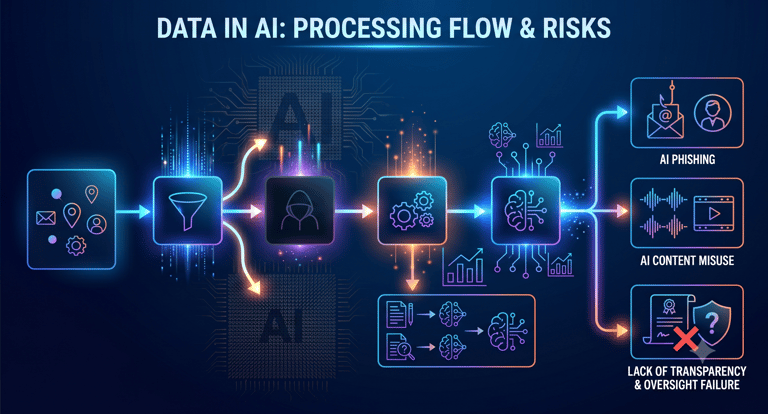
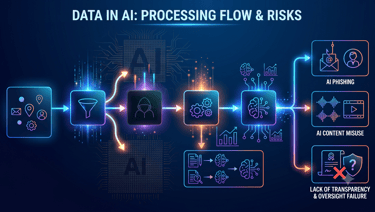
The Specific Ways AI Creates Privacy Risks
Understanding the actual risk vectors helps you focus protection efforts where they matter most.
1. Training Data Exposure
Many AI tools — particularly consumer-facing ones use your inputs to improve their models. When an employee pastes a customer list, financial projection, or internal memo into a free AI tool, that data may become part of the model's training set. Even enterprise tools carry risk if default settings aren't reviewed and vendor contracts don't include explicit data protection commitments.
In fact, 63.6% of popular AI-enabled business software providers do not disclose third-party AI subprocessors in their legal documentation [Help Net Security, 2026]. That means you may not even know which systems are processing your data downstream.
2. Shadow AI
Shadow AI is what happens when employees use AI tools that IT and compliance teams don't know about. It's the business equivalent of shadow IT except instead of unauthorized software, it's generative AI tools processing sensitive data with no oversight.
An employee requesting a summary of client emails through an unauthorized tool may inadvertently surface documents, contacts, and conversations that were never intended to be processed by an external system. You can't govern what you can't see.
3. Data Repurposing Without Consent
AI excels at finding unexpected patterns in existing data. Customer service transcripts collected for quality assurance can become training data for recommendation engines. Purchase history gathered for analytics can feed AI models predicting churn or lifetime value.
Each of those represents a separate privacy decision and if customers only consented to the original use, expanding to AI processing may violate data protection law. The collection happened legally; the repurposing didn't.
4. AI-Powered Phishing and Social Engineering
Generative AI has dramatically lowered the barrier for attackers. Convincing phishing emails, voice clones, and deepfake content that once required significant technical skill can now be produced in minutes. Attackers craft personalized messages referencing real employees, active projects, and specific business context pulled from public sources [CMIT Solutions, 2026].
This isn't a data collection risk it's a data weaponization risk. The less personal information you expose publicly through AI tools, the smaller the attack surface.
5. Inadequate Consent and Transparency
Customers rarely know when AI is processing their data. AI can analyze behavior and build preference profiles while users interact with what looks like a standard website feature. If your privacy policy doesn't disclose AI processing, you may be non-compliant even if the processing itself is otherwise lawful.
What the Regulations Now Require
The regulatory window for treating AI data privacy as optional has closed.
EU AI Act
The EU AI Act is the most comprehensive AI-specific regulation in the world. Full application for high-risk AI systems took effect in August 2026. It requires:
Conformity assessments for high-risk AI systems
Data Protection Impact Assessments (DPIAs) for processing that poses significant risk
Human oversight mechanisms for automated decisions with significant consequences
Transparency about when users are interacting with AI
Technical documentation and incident reporting obligations
Fines are severe: up to €15 million or 3% of global annual turnover for high-risk violations, and up to €35 million or 7% for violations related to general-purpose AI models [Digital Samba, 2026].
GDPR and AI
The EU AI Act doesn't replace GDPR it adds a layer on top of it. Under GDPR, AI processing of personal data requires:
A valid legal basis (legitimate interest alone is rarely sufficient for AI)
Explicit disclosure of automated decision-making
The right to human review of significant automated decisions
Verification that any training data was lawfully obtained
The convergence of the AI Act and GDPR means organizations can no longer treat data protection and AI governance as separate workstreams. They're the same workstream now.
US State Privacy Laws
While no comprehensive US federal AI privacy law exists yet, 145 AI-related laws were enacted by US state legislatures in 2025 alone [Help Net Security, 2026]. California, Colorado, Texas, Virginia, and a growing number of states now have privacy frameworks that directly affect how AI processes personal data. If you operate across states — or sell to consumers in multiple states — patchwork compliance is no longer optional.
What Your Employees Need to Know Before Using AI Tools
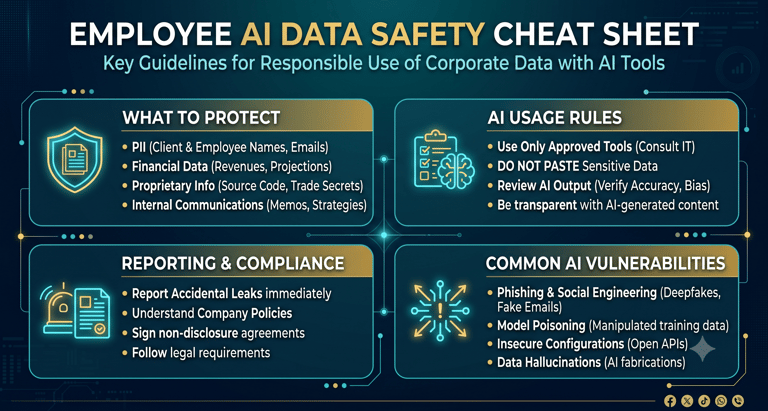
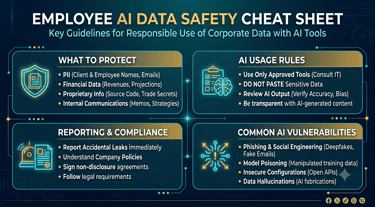
Your policies are only as effective as your team's understanding of them. Here's what every employee who touches AI tools should know:
Consumer tools vs. enterprise tools behave very differently. The free version of most AI tools defaults to using inputs for model training. The business or enterprise tier typically includes contractual data protections but those protections require deliberate setup, not automatic activation. Check which tier your organization uses, and confirm data processing terms in the vendor contract.
"I thought it was just a draft" is not a defense. If an employee pastes customer PII, confidential financial data, or protected health information into an AI tool even briefly that may constitute a data processing event under applicable law. Train staff on what counts as sensitive data before they encounter it in a prompt window.
Familiar tools can have unfamiliar reach. A Copilot prompt asking for an email summary may surface documents, calendar data, and chats that were never intended to be part of that response. Employees should understand that AI tools integrated into productivity suites often access more data than the immediate task suggests.
When in doubt, leave it out. The simplest employee guidance: if you wouldn't send the information in an unencrypted email, don't put it in an AI prompt.
How to Protect Your Business: A Practical Framework
You don't need to ban AI to manage its privacy risks. You need a governance structure that keeps pace with adoption.
Step 1: Build an AI Inventory
You can't govern what you don't know exists. Audit every AI tool currently in use across your organization including tools embedded in existing software (CRMs, productivity suites, HR platforms). Classify each by risk level based on the data it accesses.
Step 2: Review Vendor Contracts Before Data Flows
Before any AI tool processes personal data, confirm:
Does the vendor use inputs for model training? Under what conditions?
Who are their third-party AI subprocessors?
Where is data stored and processed geographically?
Does the contract include a Data Processing Agreement (DPA)?
If a vendor can't answer these questions clearly, that's your answer.
Step 3: Run Data Protection Impact Assessments
For any high-risk AI use automated hiring decisions, fraud detection, health-related processing, behavioral profiling conduct a DPIA before deployment. Document the risk, the safeguards, and the legal basis. This isn't just regulatory box-ticking; it's the process that catches problems before they become breaches.
Step 4: Create a Tiered AI Acceptable Use Policy
Define clearly:
Which AI tools are approved for use
What categories of data can and cannot be entered into AI tools
What approval process applies to new AI tool requests
What employees should do if they suspect a data incident
Make the policy specific and practical — not a wall of legal text that no one reads.
Step 5: Appoint Ownership
Only 24% of enterprises have a dedicated AI security governance team [Help Net Security, 2026]. You don't need a full department, but you do need a named owner: someone responsible for maintaining the AI inventory, monitoring regulatory changes, reviewing vendor contracts, and managing incidents when they arise.
FAQ:
Is AI a threat to data privacy?
AI itself is a tool the privacy risks come from how it's deployed and governed, not from the technology itself. The real threats are inadequate vendor contracts, shadow AI usage by employees, data repurposing without proper consent, and insufficient transparency with users. All of these are manageable with the right governance structure in place.
What data does AI typically collect or process?
It depends entirely on the tool and how it's configured. AI tools can process anything you input text, files, images, audio as well as behavioral data, usage patterns, and in some cases, data accessed from connected systems (email, calendars, CRMs). The critical question to ask every vendor is whether inputs are used for model training and who has access to stored data.
How can businesses use AI without violating privacy laws?
The core requirements are: establish a valid legal basis for processing, conduct DPIAs for high-risk use cases, ensure transparency with users when AI is processing their data, maintain human oversight for significant automated decisions, and vet vendor contracts to confirm downstream subprocessor disclosure. Operating under GDPR and the EU AI Act simultaneously means treating these as integrated obligations, not separate checklists.
What should employees do if they think they've shared sensitive data with an AI tool?
Report it immediately to their manager or data protection contact. Most regulations require breach notification within 72 hours if personal data was involved, so internal reporting speed matters. Don't wait to see if anything happens the obligation to assess and notify begins the moment a potential incident is identified.
What are the biggest AI security risks for small and mid-sized businesses?
The top three are shadow AI (unvetted tools being used without IT oversight), phishing attacks enhanced by generative AI (more convincing and personalized than ever), and vendor risk from AI-enabled software that doesn't disclose data sub processors. Larger enterprises have security teams watching for these. SMBs typically don't which makes clear employee policies and vendor due diligence even more critical.
Worrying about AI data privacy without doing anything about it is the worst outcome. The risks are real and the regulations are now in force but they're manageable.
The businesses that will get this right aren't the ones that banned AI. They're the ones that built a practical governance layer around it: an AI inventory, vetted vendor contracts, employee training, and a named person accountable for oversight.
Start this week with a single audit question: what AI tools is your team currently using, and who reviewed the data terms before they were adopted? The answer will tell you exactly where to focus first. Or you can just get the AI Blueprint Opportunity report it does exactly this.